My role was
UI/UX Designer
Company
SyFy
Project Name
M16 - Perps
Timeline
2025 - 2026
Overview
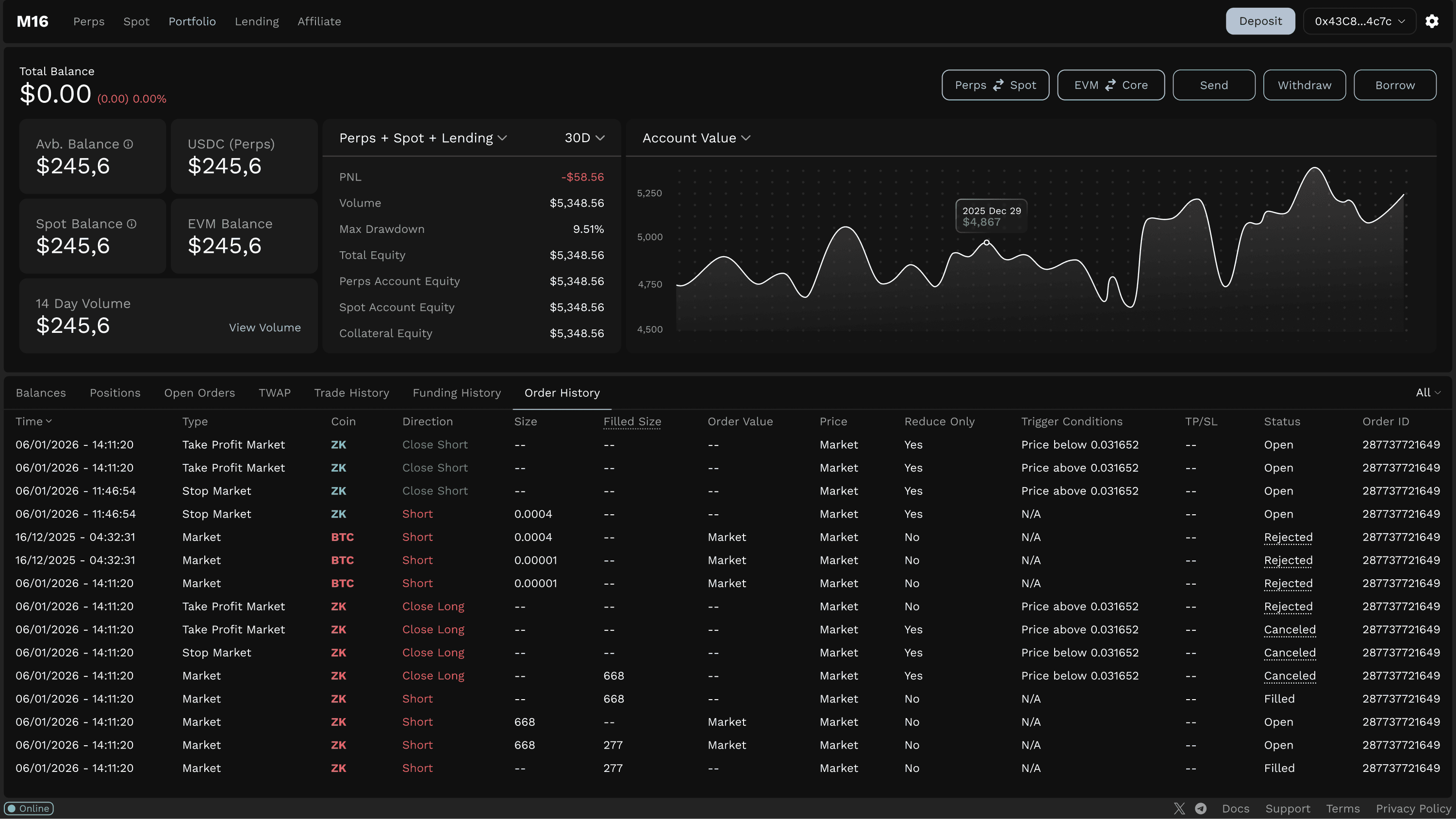
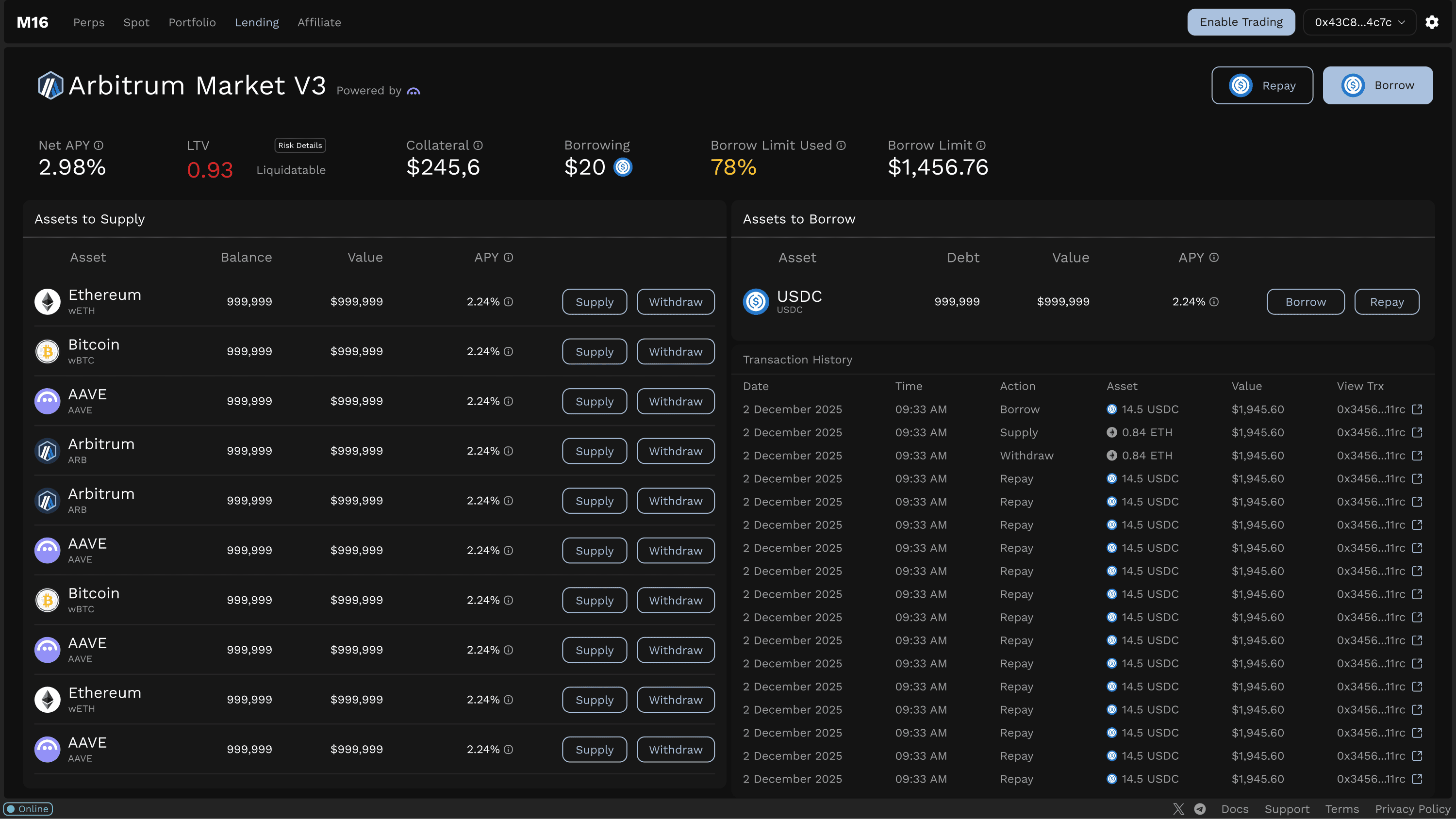
M16 is a non-custodial perpetual trading interface built on top of Hyperliquid, enabling users to trade using any asset as collateral by integrating lending and borrowing directly into the trading experience.
Hatom is a fintech ecosystem where users actively manage deposits, loans, yield and risks.
I led UX / UX improvements across lending, staking, and a stablecoin module to make complex financial actions easy to understand and control. We are now developing the V2 of the app.
Problem
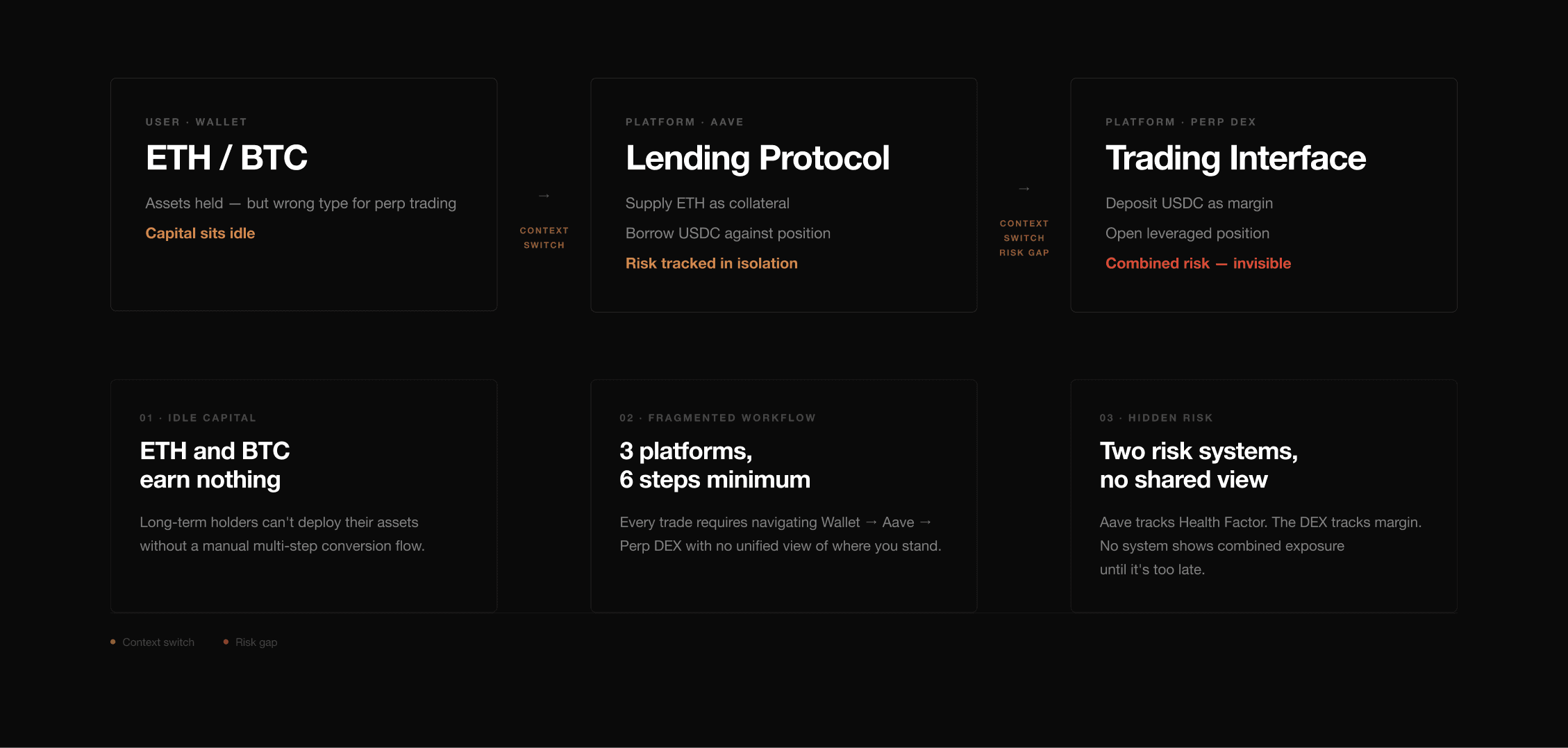
Perpetual trading in DeFi is built around a simplified assumption that users hold stablecoins and deploy them as margin.
This leads to:
idle capital (ETH, BTC not being used)
fragmented workflows (Aave → bridge → perp DEX)
poor visibility of risk across systems
From a UI/UX perspective this begs the question: How might we enable users to trade with any asset as collateral, while maintaining clarity over a multi-layered risk system?
Problem
Perpetual trading in DeFi is built around a simplified assumption that users hold stablecoins and deploy them as margin.
This leads to:
idle capital (ETH, BTC not being used)
fragmented workflows (Aave → bridge → perp DEX)
poor visibility of risk across systems
From a UI/UX perspective this begs the question: How might we enable users to trade with any asset as collateral, while maintaining clarity over a multi-layered risk system?
User Understanding
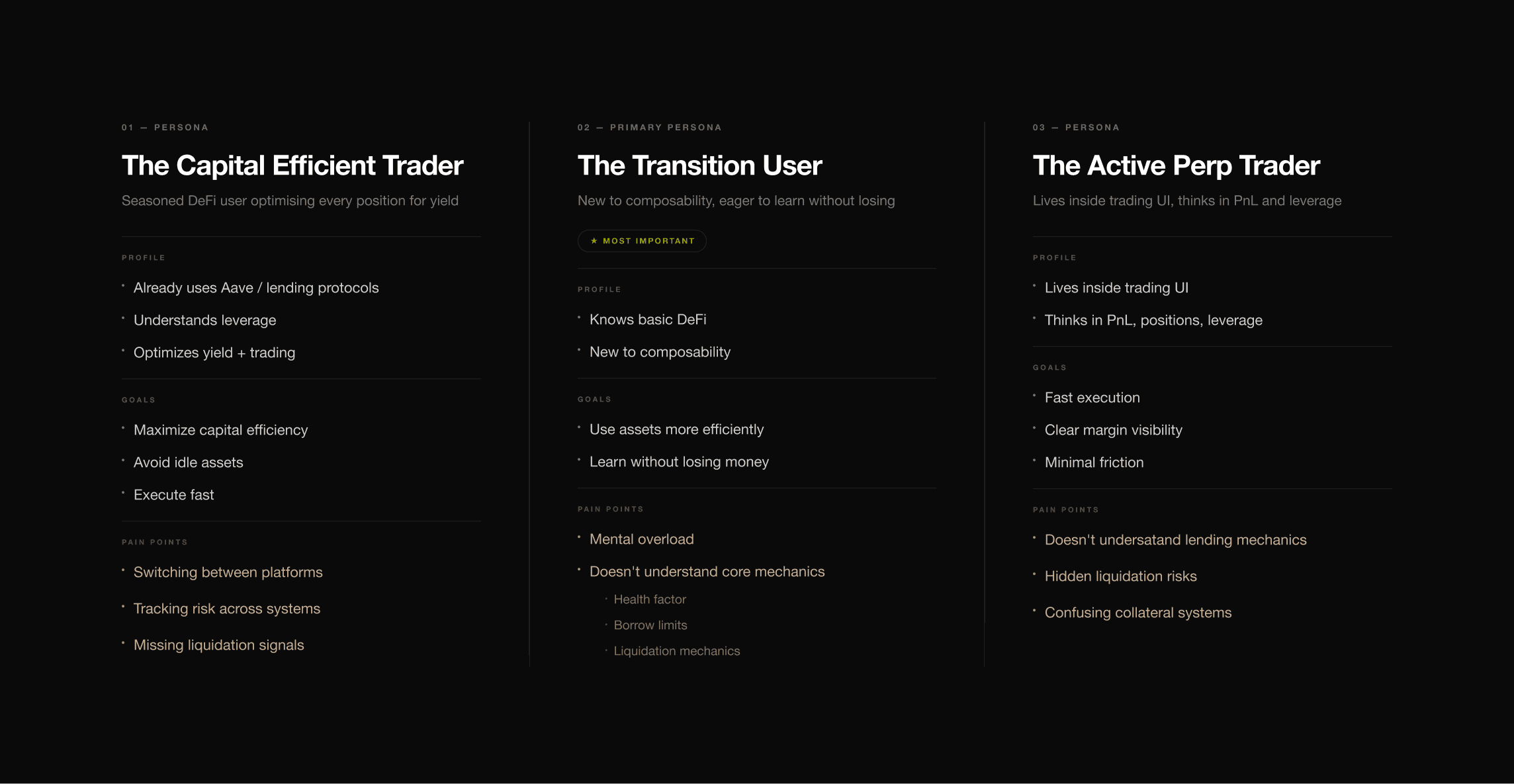
Personas were defined through behavior, not demographics, focusing on how users manage capital, risk, and decision-making in DeFi. By mapping differences in experience, trading intent, and risk tolerance, the work highlights where users diverge in understanding and where the interface needs to guide or simplify.
User Understanding
Personas were defined through behavior, not demographics, focusing on how users manage capital, risk, and decision-making in DeFi. By mapping differences in experience, trading intent, and risk tolerance, the work highlights where users diverge in understanding and where the interface needs to guide or simplify.
User Flows
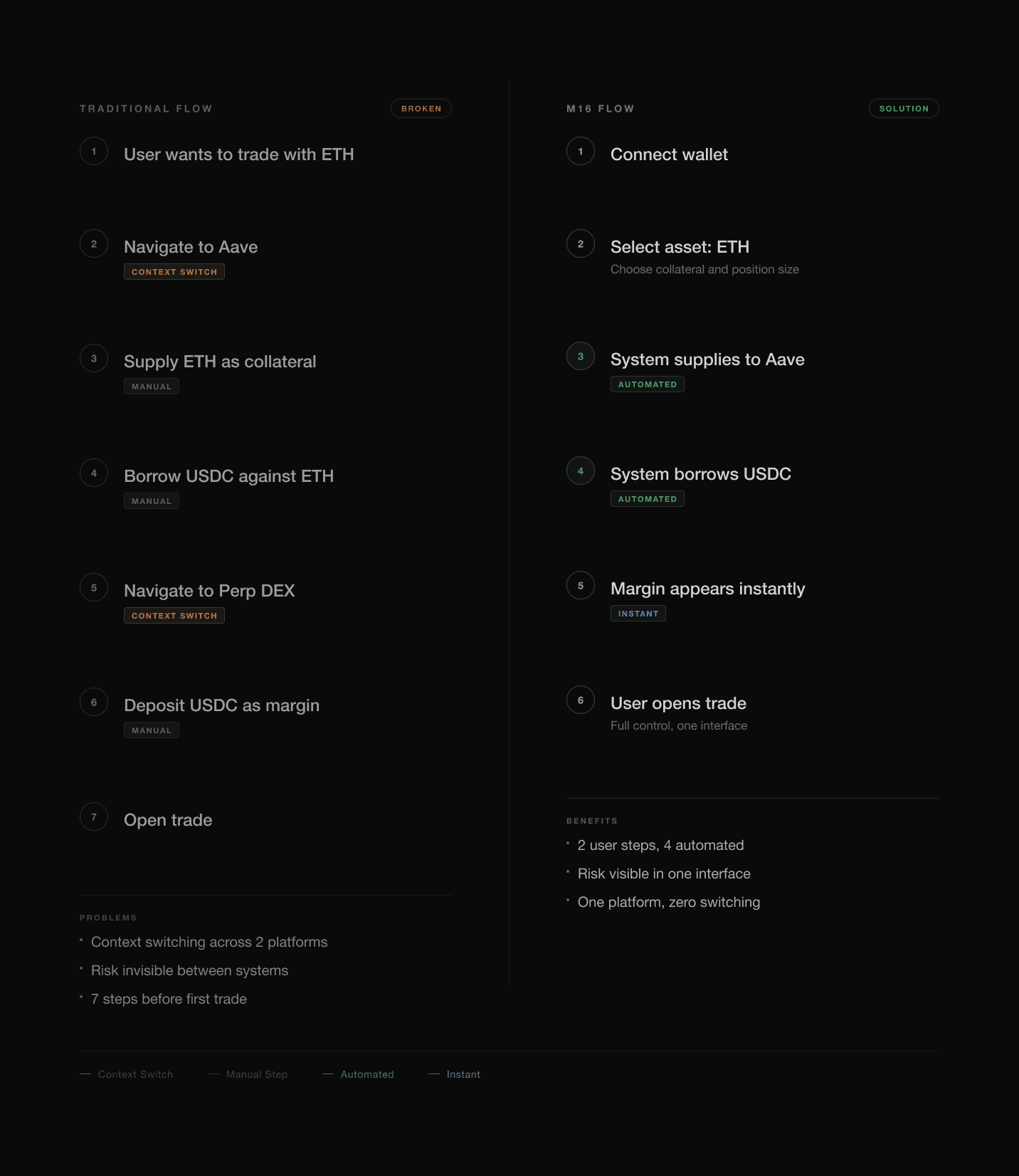
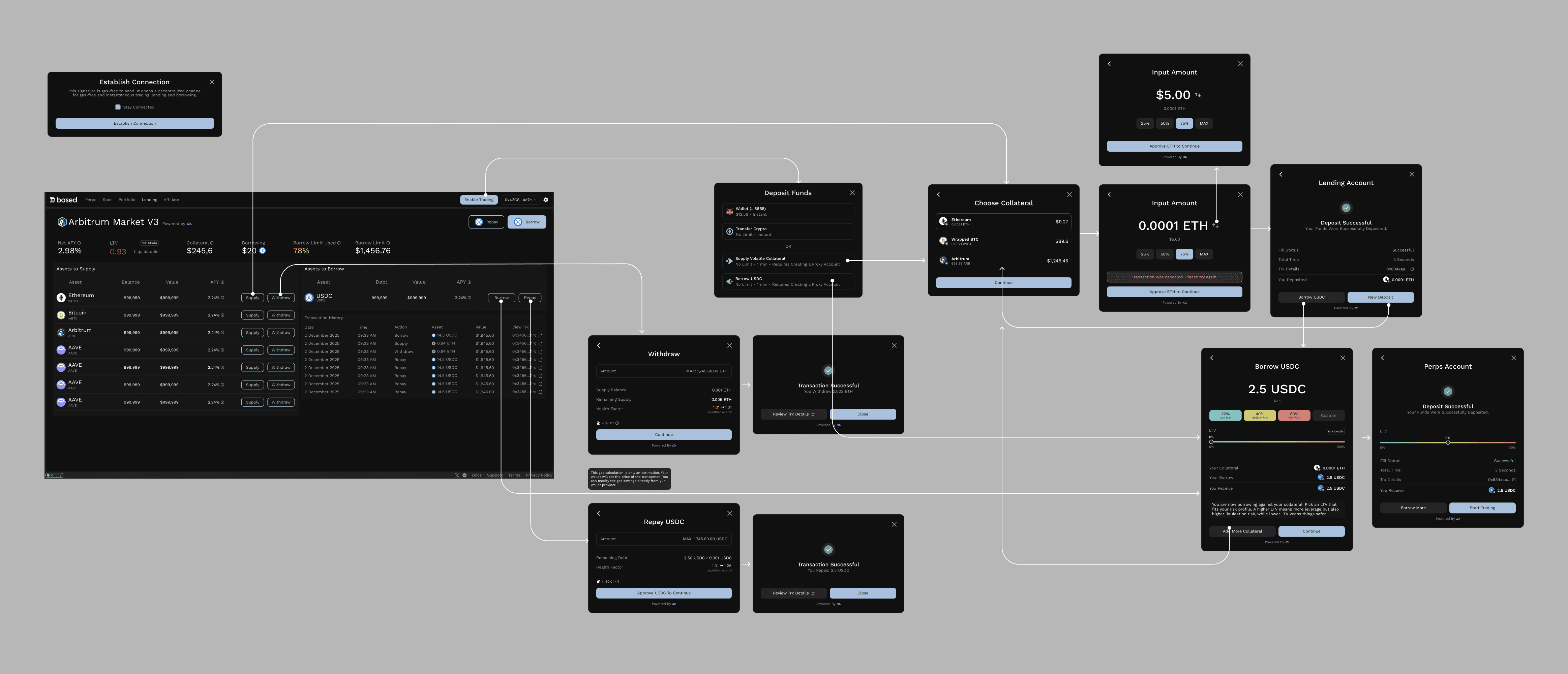
Flows were designed around complete financial cycles, entering, managing, and exiting positions, rather than isolated actions. This approach exposed friction between lending and trading layers, and clarified where users need feedback to understand consequences and act with confidence.
Information Architecture
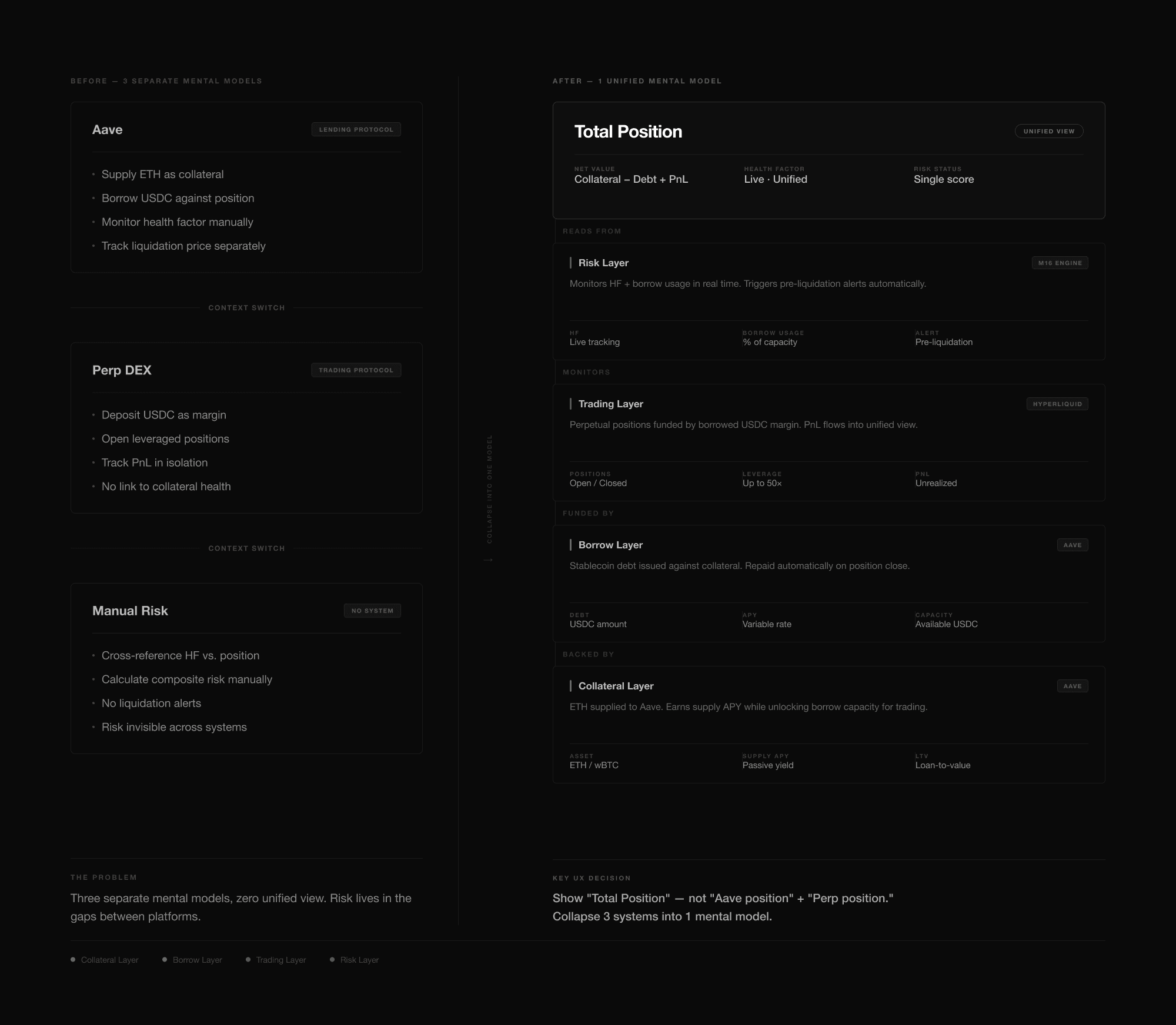
The architecture unifies collateral, borrowing, and trading into a single, coherent system. Complexity is structured into clear hierarchies, allowing users to grasp their position and risk instantly, while still having access to deeper mechanics when needed.
Outcome / Impact
Product Impact
Reduced cognitive load across multi-protocol workflows
Increased capital efficiency (assets remain productive)
Clearer understanding of liquidation risk
UX Impact
Faster decision-making
Reduced user error
Higher confidence in complex actions
Outcome / Impact
Product Impact
Reduced cognitive load across multi-protocol workflows
Increased capital efficiency (assets remain productive)
Clearer understanding of liquidation risk
UX Impact
Faster decision-making
Reduced user error
Higher confidence in complex actions
Reflections
What was challenging
Translating protocol-level mechanics into human understanding
Designing for risk without overwhelming users
Balancing abstraction vs transparency
What to improve/develop further
Simulation tools (what happens if price drops 10%)
Automation (auto-repay / alerts)
Mobile optimization for monitoring
Reflections
What was challenging
Translating protocol-level mechanics into human understanding
Designing for risk without overwhelming users
Balancing abstraction vs transparency
What to improve/develop further
Simulation tools (what happens if price drops 10%)
Automation (auto-repay / alerts)
Mobile optimization for monitoring

User Flows
Flows were designed around complete financial cycles, entering, managing, and exiting positions, rather than isolated actions. This approach exposed friction between lending and trading layers, and clarified where users need feedback to understand consequences and act with confidence.
Information Architecture
The architecture unifies collateral, borrowing, and trading into a single, coherent system. Complexity is structured into clear hierarchies, allowing users to grasp their position and risk instantly, while still having access to deeper mechanics when needed.
My role was
UI/UX Designer
Company
SyFy
Project Name
M16 - Perps
Timeline
2025 - 2026
Overview
M16 is a non-custodial perpetual trading interface built on top of Hyperliquid, enabling users to trade using any asset as collateral by integrating lending and borrowing directly into the trading experience.
Hatom is a fintech ecosystem where users actively manage deposits, loans, yield and risks.
I led UX / UX improvements across lending, staking, and a stablecoin module to make complex financial actions easy to understand and control. We are now developing the V2 of the app.
Problem
Perpetual trading in DeFi is built around a simplified assumption that users hold stablecoins and deploy them as margin.
This leads to:
idle capital (ETH, BTC not being used)
fragmented workflows (Aave → bridge → perp DEX)
poor visibility of risk across systems
From a UI/UX perspective this begs the question: How might we enable users to trade with any asset as collateral, while maintaining clarity over a multi-layered risk system?
Problem
Perpetual trading in DeFi is built around a simplified assumption that users hold stablecoins and deploy them as margin.
This leads to:
idle capital (ETH, BTC not being used)
fragmented workflows (Aave → bridge → perp DEX)
poor visibility of risk across systems
From a UI/UX perspective this begs the question: How might we enable users to trade with any asset as collateral, while maintaining clarity over a multi-layered risk system?
User Understanding
Personas were defined through behavior, not demographics, focusing on how users manage capital, risk, and decision-making in DeFi. By mapping differences in experience, trading intent, and risk tolerance, the work highlights where users diverge in understanding and where the interface needs to guide or simplify.
User Understanding
Personas were defined through behavior, not demographics, focusing on how users manage capital, risk, and decision-making in DeFi. By mapping differences in experience, trading intent, and risk tolerance, the work highlights where users diverge in understanding and where the interface needs to guide or simplify.
User Flows
Flows were designed around complete financial cycles, entering, managing, and exiting positions, rather than isolated actions. This approach exposed friction between lending and trading layers, and clarified where users need feedback to understand consequences and act with confidence.
Information Architecture
The architecture unifies collateral, borrowing, and trading into a single, coherent system. Complexity is structured into clear hierarchies, allowing users to grasp their position and risk instantly, while still having access to deeper mechanics when needed.
Outcome / Impact
Product Impact
Reduced cognitive load across multi-protocol workflows
Increased capital efficiency (assets remain productive)
Clearer understanding of liquidation risk
UX Impact
Faster decision-making
Reduced user error
Higher confidence in complex actions
Outcome / Impact
Product Impact
Reduced cognitive load across multi-protocol workflows
Increased capital efficiency (assets remain productive)
Clearer understanding of liquidation risk
UX Impact
Faster decision-making
Reduced user error
Higher confidence in complex actions
Reflections
What was challenging
Translating protocol-level mechanics into human understanding
Designing for risk without overwhelming users
Balancing abstraction vs transparency
What to improve/develop further
Simulation tools (what happens if price drops 10%)
Automation (auto-repay / alerts)
Mobile optimization for monitoring
Reflections
What was challenging
Translating protocol-level mechanics into human understanding
Designing for risk without overwhelming users
Balancing abstraction vs transparency
What to improve/develop further
Simulation tools (what happens if price drops 10%)
Automation (auto-repay / alerts)
Mobile optimization for monitoring
User Flows
Flows were designed around complete financial cycles, entering, managing, and exiting positions, rather than isolated actions. This approach exposed friction between lending and trading layers, and clarified where users need feedback to understand consequences and act with confidence.
Information Architecture
The architecture unifies collateral, borrowing, and trading into a single, coherent system. Complexity is structured into clear hierarchies, allowing users to grasp their position and risk instantly, while still having access to deeper mechanics when needed.